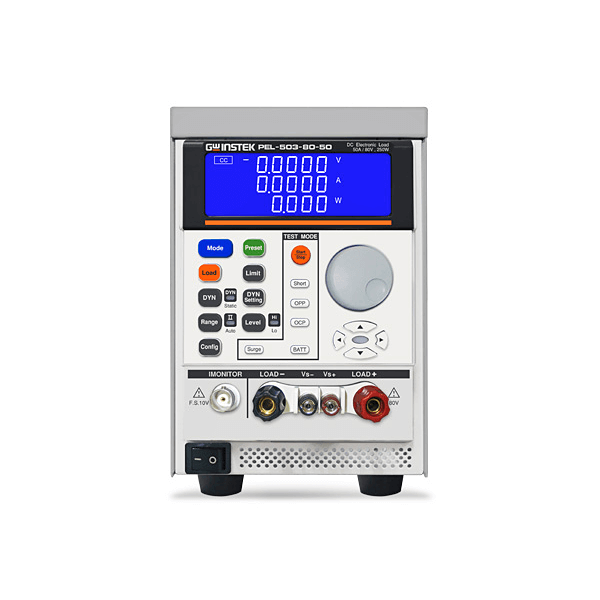
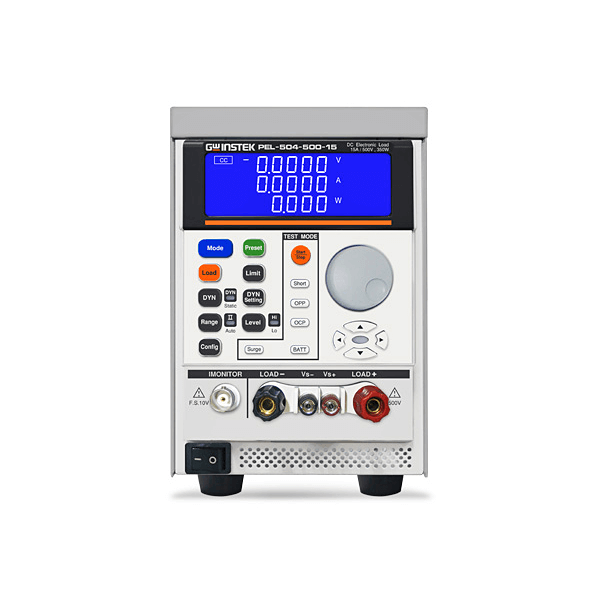
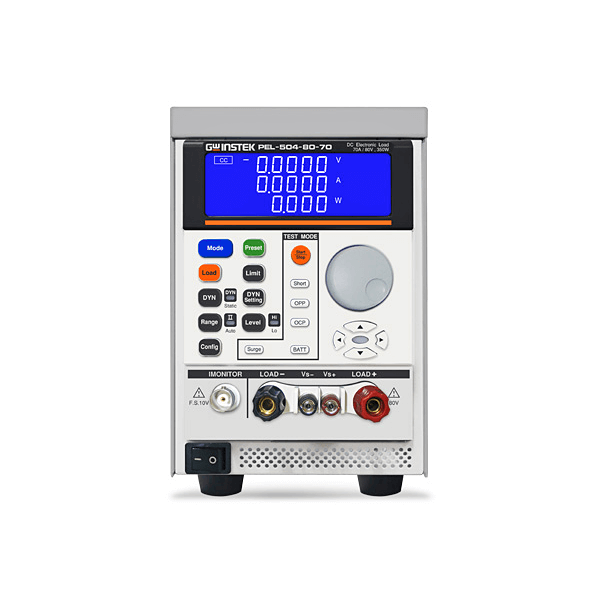
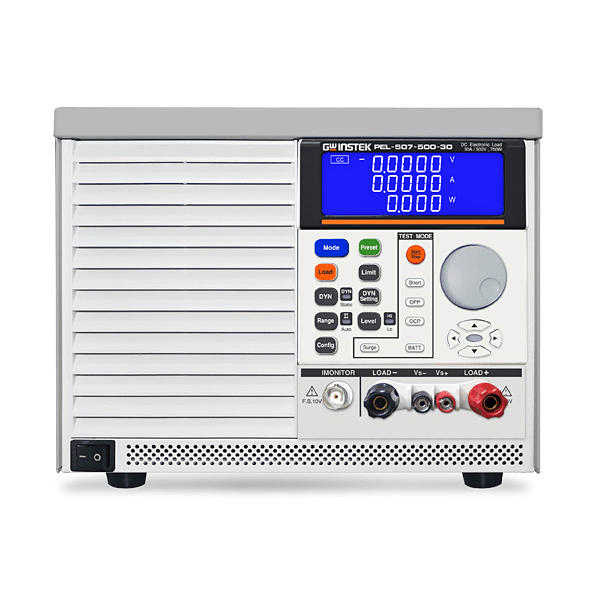
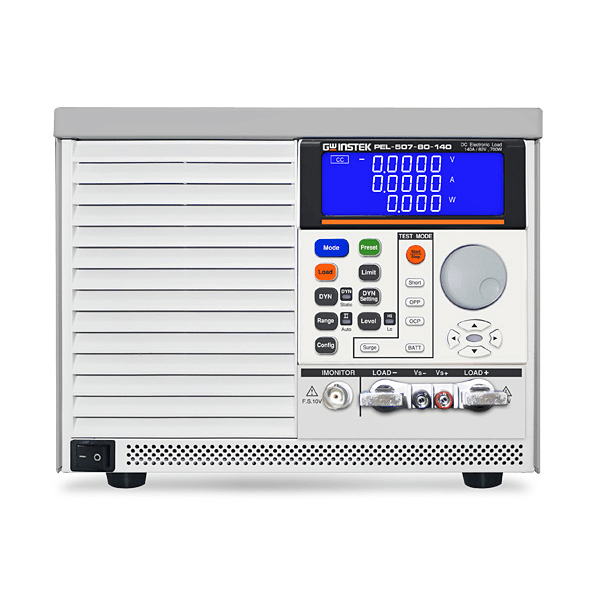
The GW Instek PEL-500 series includes 5 variants of electronic loads . Depending on the model, the 1-channel DC loads offer voltage ranges from 0 - 80 V or 0 - 500 V, models with 15 A, 30 A, 50 A, 70 A and 140 A and a power range of 250 - 700 W.
The PEL-500 series electronic loads are ideal for all research and development (R&D), quality control, ATE system and production testing applications , including voltage source / power source test, switched mode power supply transient behavior, constant voltage mode for current limit test, battery simulation and battery discharge test .
The PEL-500 series offers a 5-digit digital display for voltage, current and power , which enables you to monitor the measurement data of the device under test at the same time. The electronic loads have an overshoot test that simulates the boot overshoot current and the transient current from hot plugging to assess whether the device under test can withstand the overshoot current. The built-in battery discharge test function can determine the conditions for stopping discharge according to the test requirements of the device under test, including setting the discharge stop voltage (Vbatt), discharge capacity (AH, WH) and stop discharge time.
Set the load voltage / unload voltage of the PEL-500 for the test according to the characteristics of the device under test. When the output voltage of the device under test rises to the value of the charging voltage, the load begins. When the output voltage drops to the discharge voltage, the loading stops. Users can use the GO / NG function to set the evaluation conditions according to the function and specifications of the device under test. The PEL-500 series automatically generates the assessment results during the test according to the set assessment conditions.
According to the safety test requirements of the power supply, the PEL-500 series provides not only a short test function but also the automatic test function of overcurrent protection / overpower protection to simplify the complicated manual operation by the user and verify the OCP / OPP.
The PEL-507-80-140 variant of the GW Instek PEL-500 series presented here has an input of up to 700 W, up to 80 V, up to 140 A. Other variants have inputs up to 500 V, 15 A / 50 A / 30 A / 70 A and over 250 W / 350 W.
Product features:
- 5-digit digital voltage, current and power meter
- Simultaneous display of voltage, current and power
- Adjustable short-circuit time for short-circuit test
- Automatic test function of overcurrent protection OCP / overpower protection OPP
- The battery discharge test function can set the discharge stop voltage (Vbatt), discharge capacity (AH, WH) and discharge stop time
- The overvoltage test can simulate the boot overshoot current and the transient current from hot plugging
- Constant current, constant resistance, constant voltage, constant power and dynamic mode
- Overvoltage, overcurrent, overpower, overtemperature protection and reverse polarity detection
- Voltage polarity display can be set to a positive value ("+") or a negative value ("-")
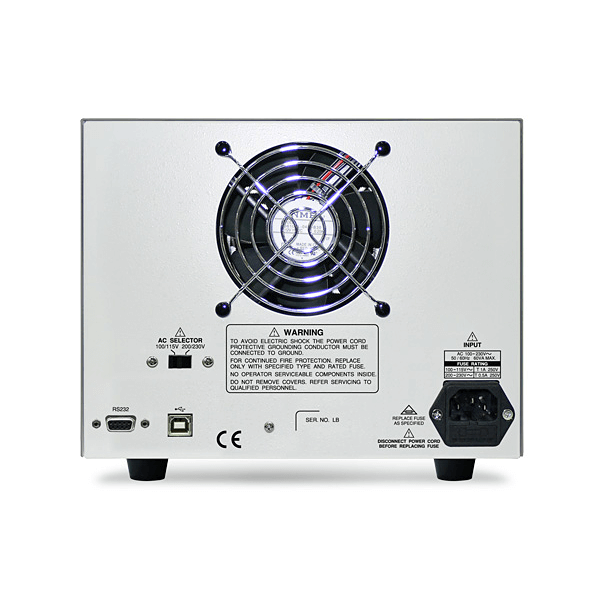
- Communication interface: RS232, USB





.webp "Seminar LabVIEW Core 3")