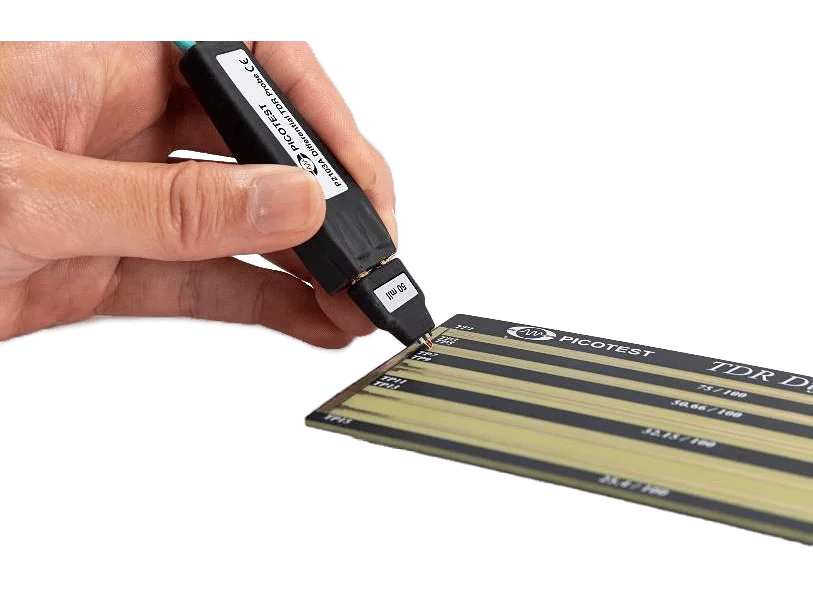

#statusMessage#
Do you want to start the comparison now?

This article compares two approaches for TDR measurement (time domain reflectometry): using the PicoVNA vector network analyzer and using a sampling oscilloscope from the PicoScope 9300 Series.
TDR is a proven method for measuring the impedance of transmission lines and for identifying discontinuities caused by connectors or damaged sections of cable. Impedance mismatches generate reflections whose waveform and amplitude indicate the type of mismatch. In the related method of time domain transmission (TDT), the signal is measured after passing through the DUT (device under test). TDT is suitable for correctly assessing transmission behavior, losses, and signal distortion.
TDR and TDT measurements are performed in the time domain. A vector network analyzer (VNA), by contrast, operates in the frequency domain and captures amplitude and phase as vector quantities. VNA measurements provide information about the matching quality between the source (the VNA) and the DUT. TDR/TDT analyses deliver fast results, while scalar and vector frequency analyses offer a wider dynamic range. Methods such as the inverse Fourier transform allow conversion of results between the time and frequency domains, providing greater flexibility in analysis. Time domain measurements are especially helpful when the position of an interference source must be determined. The physical distance to the fault location can be derived from the reflection delay and the propagation velocity.
Concrete diagnostic information can be derived from TDR measurements. The resulting measurement traces show where inductive or capacitive impedance changes occur along the transmission line. These effects can then be traced back to tangible causes such as solder quality, connector geometry, or assembly errors. This is precisely the practical benefit of TDR: it provides not only a signal image, but also an actionable fault diagnosis.
The system bandwidth, or more precisely the system rise time of the entire test setup (signal source, oscilloscope, and test cables), determines the time resolution of the TDR measurement and therefore the spatial resolution. To quantify a mismatch, the pulse amplitude must be cleanly represented over the full rise and fall time. To identify the position of a mismatch, however, a significantly finer distance resolution is sufficient, typically by a factor of about five.
The available pulse amplitude and amplitude stability can also play a role, but they are less critical than is often assumed. In practice, this means: even if the signal source can deliver a high voltage, the actually usable level is limited by the oscilloscope’s maximum input voltage. A large source amplitude is still useful because it allows the use of an attenuator between the source and the DUT, thereby improving the impedance matching and measurement quality of the test system.
An adjustable amplitude offers the advantage that the signal level can be optimally matched to the DUT. This makes better use of the available dynamic range and protects voltage-sensitive DUTs. System-related pulse distortions are of secondary importance in TDR/TDT because they are largely compensated by port calibration (open, short, load).
For the present method comparison, a cable from the defense industry is measured. To demonstrate TDR measurement with a VNA and a sampling oscilloscope, a typical question is used as the basis: where in the cable does a mismatch occur that can impair signal transmission reliability or even lead to failures?
The PicoScope 9300 Series includes sampling oscilloscopes with a bandwidth of up to 30 GHz. The maximum input voltage is 1 V (peak). The integrated pulse generator produces steps from 2.5 to 7 V (60 ps rise time), allowing the test setup to be optimized with an attenuator. Alternatively, an external PG900 pulse generator can be used.
Since an oscilloscope captures only scalar quantities, S-parameters cannot be derived from the measurement.
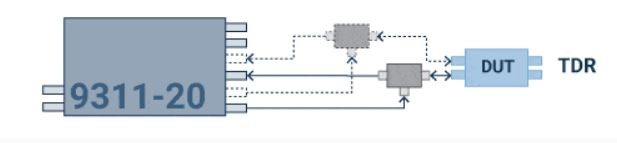
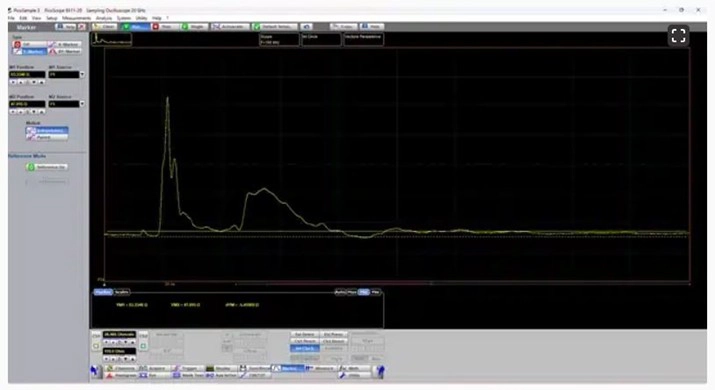
Image: Schematic representation of a typical test setup using the PicoScope 9300 with TDR function // Source: Pico Technology
Image: TDR measurement result with the PicoScope 9300 (DUT: defense cable) // Source: Pico Technology
In conventional TDR measurement, a fast voltage pulse is injected into the DUT. The faster the pulse rise time, the higher the test frequency.
The PicoVNA does not generate the TDR response from an actually injected pulse like the sampling oscilloscope, but from a broadband frequency measurement (sweep) of the reflected vector data S11. An inverse discrete Fourier transform (IDFT) is first used to calculate the DUT pulse response; integrating this then yields the step response typical of TDR. This enables time domain analysis even though the VNA operates in the frequency domain.
Time domain information from frequency data is typically obtained using low-pass and band-pass methods. The PicoVNA measurement software uses the low-pass method.
When transforming from the frequency domain to the time domain, a window function is required so that the frequency data tapers cleanly to zero at the edges. Specifically, the window function is applied to the finite set of S-parameter data in the frequency domain before the inverse fast Fourier transform (IFFT) is performed.
The PicoVNA offers the following options:
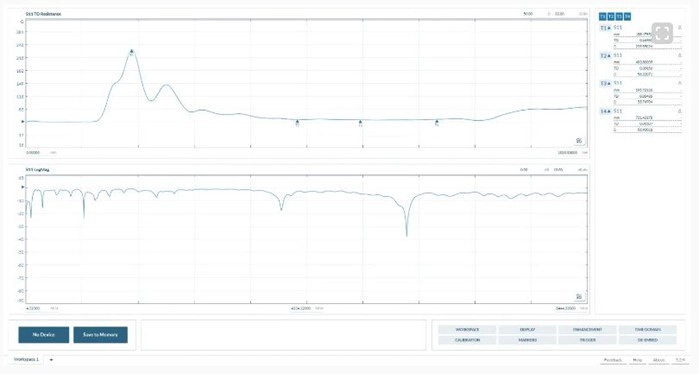
Image: TDR measurement result with the PicoVNA 108 (DUT: defense cable, time resolution: 59 ps, distance resolution: 19.5 mm) // Source: Pico Technology
The following table shows how a change in the VNA frequency sweep affects resolution and measurement range. Changing the number of frequency steps (N) has no influence on the resolution, but it does change the measurement range. Increasing the maximum frequency improves the resolution, but reduces the measurement range.
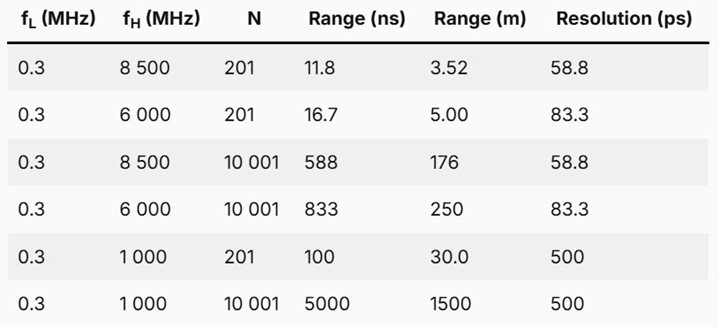
Table: Frequency and sweep settings on the VNA influence resolution and measurement range // Source: Pico Technology
Both the PicoScope 9300 and the PicoVNA deliver precise and comparable TDR measurement results when correctly configured and calibrated. Actionable diagnostic results can be derived from the measurements by revealing impedance mismatches caused by inductive or capacitive transitions (connectors), which can, for example, be traced back to soldering or assembly problems.
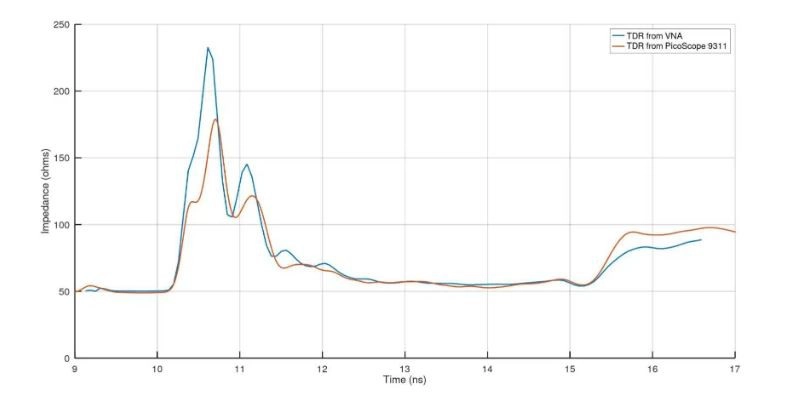
Image: Differences between the TDR measurement results of the PicoScope 9300 (blue) and PicoVNA 108 (red), using a test cable from the defense industry as an example // Source: Pico Technology
Both measurement systems deliver precise TDR results. In practice, however, the key factor is how such measurements help diagnose signal transmission problems. An application example illustrates this:
A test cable consists of an SMA connector with ferrule on a rigid coaxial cable and a BNC connector with ferrule at the other end. To assess connection quality, time domain transmission (TDT) is used instead of TDR. Why?
TDR is suitable for locating impedance discontinuities and reflections. TDT is better suited in this application because it evaluates the transmission behavior over the entire cable length. For assessing an assembled cable, this aspect is closer to the actual question: does the signal arrive cleanly and with sufficient quality at the other end?
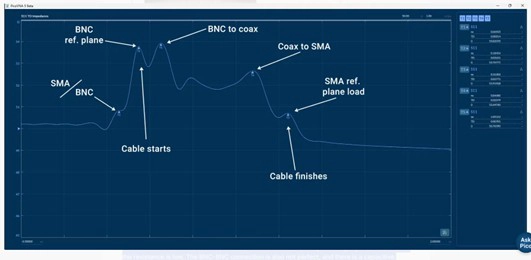
Image: Result of a TDT measurement with the PicoVNA (test cable) // Source: Pico Technology
Explanation: The transition from the PicoVNA 108 to the SMA-BNC adapter behaves slightly inductively, so the resistance is low. The BNC-BNC connection shows capacitive behavior. The transition from the ferrule to the coaxial cable shows a peak of 55 Ω, corresponding to the specification. The nearly flat section of the trace corresponds to the cable itself. At the end of the cable, a second transition is visible; due to better soldering, this is less pronounced. It is also evident that SMA connections are better suited for high-frequency systems than BNC connections.
Sampling oscilloscope and VNA are not competing tools, but complementary ones. Together, both systems provide a comprehensive view of the signal integrity of modern high-frequency systems.
Time domain and frequency domain measurements complement each other in the characterization of transmission lines. TDR and TDT with the oscilloscope enable rapid localization of fault points in cables and connectors. The vector network analyzer, by contrast, provides detailed analysis in the frequency domain and can also display measurement data in the time domain. Both measurement approaches deliver reliable results when correctly calibrated. The choice of method depends on the diagnostic objective: time domain measurements with the oscilloscope are especially suitable for fault location, while VNAs are suitable for comprehensive spectral evaluation or for strongly frequency-dependent applications.

.png "USB sampling oscilloscope for PC, 2-channel, 20 GHz, integr. TDR / TDT")
.png "VNA 108")