#statusMessage#
Do you want to start the comparison now?
#statusMessage#
Do you want to start the comparison now?
How Thermography Enhances Manufacturing. Machine stoppages, component overheating, or electrical faults—unplanned downti...
Disturbances in the power grid often go unnoticed until systems shut down or equipment fails. Regular power quality asse...
In this practical checklist you will learn how to calibrate your measuring and test instruments effectively – simply, ef...
Modern oscilloscopes of the MXO Series from Rohde & Schwarz enable precise analysis and optimization of electric drivetr...
Manufacturer number: P2106A-20X-50-20K-B
| Weight (kg): | 0 |
|---|
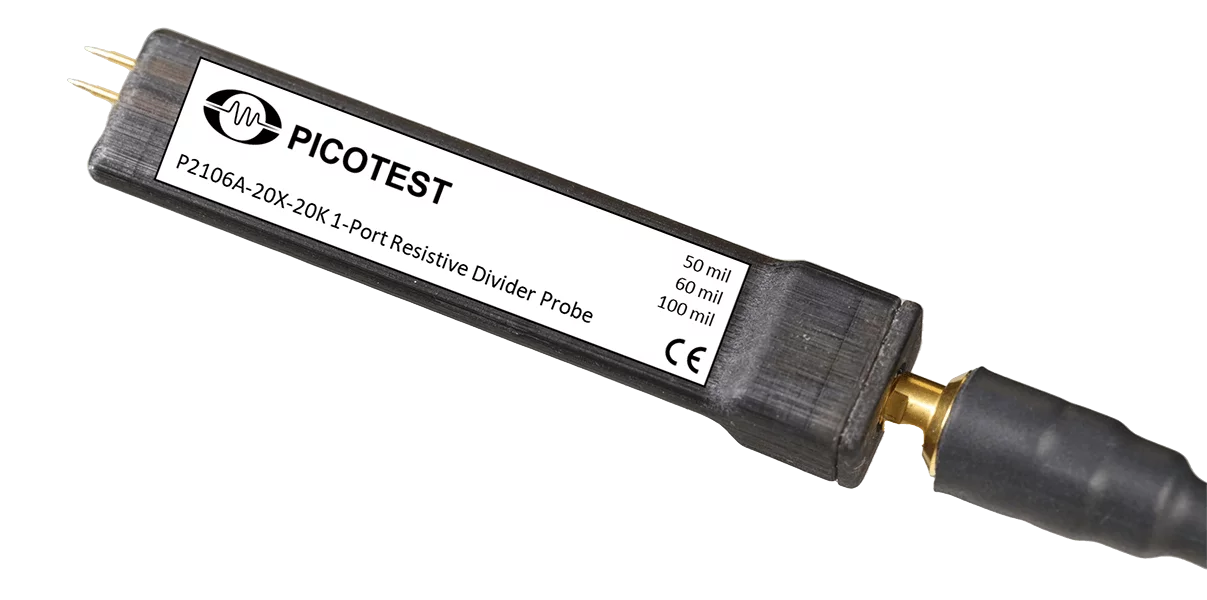
The Picotest P2106A probe is a high impedance voltage divider 'browser' probe specifically designed for low bandwidth and non-resonant performance. Coupled with the Picotest J2180A low-noise amplifier and PDN cable, the low-noise measurement can be connected directly to any 50 ohm meter, including signal analyzers, spectrum analyzers and low-noise oscilloscopes. The P2106A offers one of the lowest noise test solutions, enabling measurement of sensitive power supplies for power amplifiers and telecom equipment up to 65V.
The bottom resistance is usually 1K and the resistance at the top determines the attenuation. The P2106A-20K-20X has a peak resistance of about 19K and a bottom resistance of 1K. This ~1kOhm Thevenin impedance together with the coax cable (30pF/ft) and the input capacitance of the J2180A low-noise preamplifier (~36pF) forms a low-pass filter (Fbw=1/(2*PI*1k*125pF)=1.2MHz. The capacitance at the probe tip is essentially zero. The general application is to connect a relatively high Z uncompensated probe to the J2180A amplifier, to transmit a low-noise, low-bandwidth signal to a 50 ohm device.
The P2106A is available with fixed pin spacing of 50, 60 or 100 mil and with different attenuations. In addition to the P2106A-20X-50-20K-B presented here with 20x attenuation, 50 mil and BNC connection, the P2106A is also available in the following variants: